
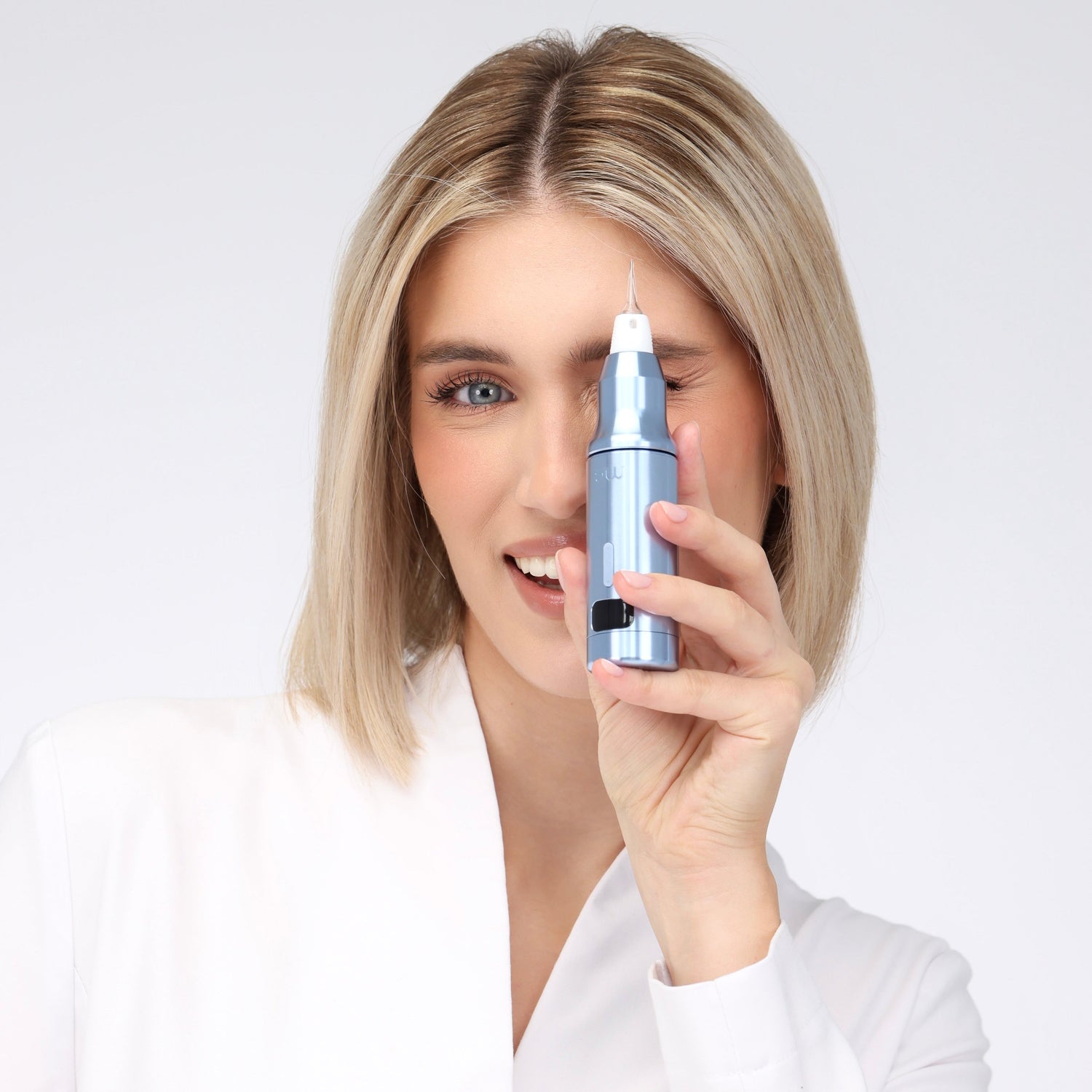
Stroke length is one of the most frequently discussed parameters in permanent makeup devices. It is often presented as if the number alone determined whether a machine is soft, powerful, universal, or suitable for a particular technique.
In reality, stroke length is only one part of a much larger mechanical system. Understanding what it defines—and what it does not—allows artists to choose their equipment more consciously and adapt their technique with greater precision.
What Does Stroke Mean in Mechanical Terms?
Needle stroke is the total linear distance traveled by the needle during one complete operating cycle—from its fully retracted position to its furthest forward position.
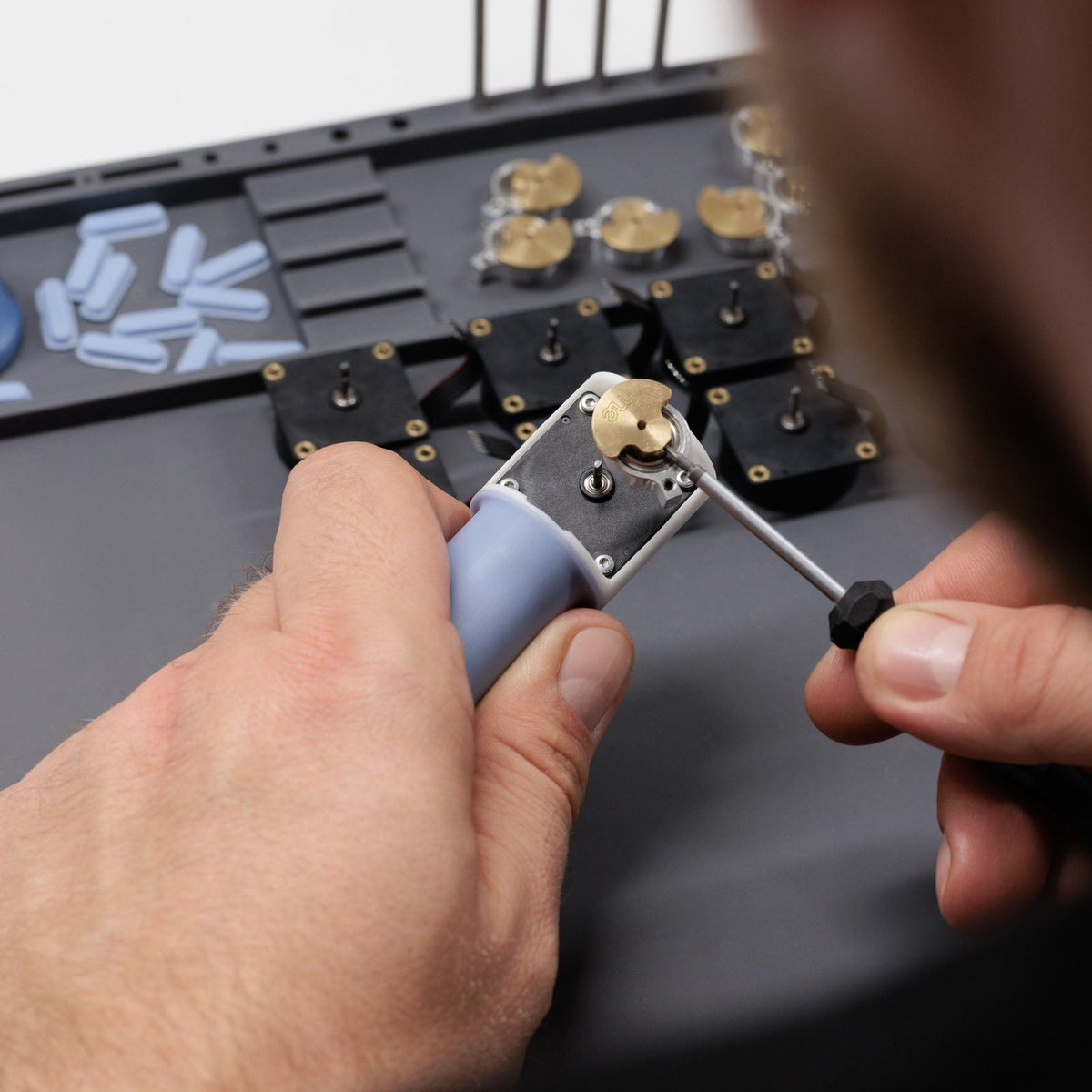
In a rotary device, this movement is generated by the motor and drive mechanism. The eccentric converts the rotary motion of the motor shaft into the reciprocating motion of the needle.
Stroke is therefore a geometric parameter: it defines the range of needle movement.
At the same operating frequency and with a comparable motion profile, a longer stroke generally produces greater peak needle velocity and acceleration. However, stroke alone does not determine:
-
the device’s power,
-
the actual force delivered to the tissue,
-
the amount of pigment implanted,
-
the depth of implantation,
-
or the duration of needle contact with the skin.
These depend on the complete drive system, the moving mass, motor torque, electronic control, cartridge resistance, needle configuration, operating frequency, needle protrusion, hand movement, pressure, and tissue response.
Stroke creates the conditions for a particular movement characteristic. The engineering of the device determines how effectively and consistently that movement is produced.
Why Can Two Devices with the Same Stroke Perform Differently?
Stroke length alone does not define the quality or character of a machine.
The final behavior of the needle depends on how effectively all components work together, including:
-
motor architecture and torque characteristics,
-
eccentric and drive geometry,
-
bearings, pusher, guides, and moving mass,
-
production tolerances and mechanical alignment,
-
cartridge resistance,
-
stability of the power supply,
-
and the design of the electronic control system.
This is why two devices listed as having the same 3.5 mm stroke can behave completely differently in practice.
One may remain smooth, stable, and consistent under load. Another may lose speed, produce excessive vibration, sound uneven, or feel stiff and difficult to control.
The difference is not found in the stroke value itself. It is found in how accurately the device generates, transfers, and controls the movement.
Stroke Efficiency Depends on the Entire Construction
A stroke is effective only when the drive system can complete each cycle consistently under real working conditions.
Resistance changes during a procedure. Different cartridges, needle groupings, pigments, and tissue types create different loads. A properly engineered device must respond to these changes without allowing its operating characteristics to become unstable.
The artist then translates the mechanical potential of the device into effective pigmentation through:
-
operating frequency,
-
hand movement,
-
pressure control,
-
needle protrusion,
-
cartridge choice,
-
pigment consistency,
-
and a working technique adapted to the condition of the skin.
The machine and the artist therefore do not operate independently. Engineering determines the movement available to the artist, while technique determines how that movement interacts with the tissue.
2.8 mm vs. 3.5 mm Stroke
The following comparison describes general mechanical tendencies, assuming a comparable drive design, operating frequency, and motion profile.
| Stroke length | Mechanical characteristic | Typical working character |
|---|---|---|
| 2.8 mm | Shorter axial travel; generally lower peak needle velocity and acceleration at the same frequency | Often perceived as softer and more controlled; supports gradual saturation and layered work |
| 3.5 mm | Longer axial travel; generally higher peak needle velocity and acceleration at the same frequency; places greater demands on the drive system | Often feels more direct and decisive; can support efficient implantation with a lighter hand when the device remains stable under load |
These are tendencies, not fixed rules.
A 2.8 mm device is not automatically gentle, and a 3.5 mm device is not automatically aggressive. Motor behavior, control strategy, mechanical balance, frequency, cartridge resistance, and the artist’s technique can significantly change how either stroke performs.
Both stroke lengths can be used for different PMU techniques. The distinction lies less in what can be performed and more in how the artist needs to work to achieve the intended result.
Can One Device Be Universal?
A universal PMU device should not be understood as a machine that behaves identically in every situation. No electromechanical system maintains exactly the same performance regardless of load, available power, cartridge resistance, or thermal conditions.
Universality means that the device offers a sufficiently stable and controllable operating range to support different techniques, skin types, needle configurations, and working styles.
The electronic control system plays an important role in this stability.
In a simple open-loop system, the controller applies a specified voltage or PWM duty cycle without directly correcting the actual motor behavior under changing load. As resistance increases or battery voltage decreases, speed and needle movement may change.
In a closed-loop system, the controller uses feedback to monitor selected operating parameters and adjust the motor drive accordingly.
Depending on the design, feedback may be obtained from an encoder, current measurement, back-EMF estimation, Hall-sensor data, or a combination of several methods.
However, the presence of Hall sensors alone does not prove that a device uses closed-loop speed or torque regulation. In many BLDC motors, Hall sensors are used only for correct motor commutation.
PWM is a method of controlling the electrical power supplied to the motor. Its presence does not automatically mean that the system measures or corrects the actual behavior of the drive.
When properly designed, a feedback-based control system can compensate for changing load and maintain more consistent operating characteristics—within the current, voltage, power, and thermal limits of the device.
From a practical perspective, both 2.8 mm and 3.5 mm strokes can be versatile:
-
2.8 mm supports more gradual, layered work and can offer a softer response on delicate or reactive tissue.
-
3.5 mm provides a more pronounced movement characteristic and can support efficient implantation with less hand pressure, provided that the drive remains stable under load.
Neither stroke is universally superior. Each gives the artist a different mechanical starting point.
Needle Protrusion: A Separate but Complementary Parameter
Needle protrusion is frequently confused with stroke length, but the two parameters describe different things.
-
Stroke is the total distance traveled by the needle during one cycle.
-
Needle protrusion is the distance the needle extends beyond the cartridge tip at its furthest forward position.
Needle protrusion does not equal implantation depth. The actual interaction with the skin also depends on hand pressure, working angle, tissue deformation, skin tension, device movement, and the artist’s control.
As practical starting ranges for ME™ devices and compatible cartridge configurations:
-
2.8 mm stroke: approximately 1.4–2.0 mm protrusion,
-
3.5 mm stroke: approximately 1.75–2.0 mm protrusion.
These values should not be treated as universal rules for all machines and cartridges. Cartridge construction, needle grouping, membrane resistance, pigment viscosity, technique, and treatment area must also be considered.
Excessive protrusion may reduce effective pigment supply because the needle spends less of each cycle within the pigment-containing area of the cartridge tip. Insufficient protrusion may reduce visibility, cause the cartridge tip to interfere with movement, and make tissue interaction more difficult to control.
During each operating cycle, the needle passes through three main phases:
-
Extension – the needle moves toward the cartridge opening and extends beyond the tip.
-
Tissue interaction – the needle contacts the skin as the device is guided across the treatment area.
-
Retraction – the needle returns into the cartridge tip and is re-wetted with pigment.
The retraction phase is important for maintaining a continuous pigment supply. However, pigment flow does not depend on retraction alone. It is also influenced by cartridge geometry, needle grouping, capillary action, pigment viscosity, and the operating frequency of the device.
The objective is to create a stable cycle in which the needle is consistently supplied with pigment while the artist retains control over tissue interaction.
There Is No Single Ideal Stroke
There is no universally ideal stroke length because there is no single device construction, skin type, pigment consistency, needle configuration, or working technique.
Stroke should not be evaluated as an isolated number. It must be considered together with:
-
motor and drive design,
-
torque behavior under load,
-
electronic control,
-
operating frequency,
-
needle protrusion,
-
cartridge characteristics,
-
pigment properties,
-
and the artist’s technique.
There is also no inherently “better” or “worse” stroke—just as there is no universally superior pencil grade. An artist does not compare H, HB, 2B, and 5B to determine which pencil is objectively best. Each is selected according to the effect that needs to be created.
The same principle applies to PMU devices.
A shorter and a longer stroke provide different movement characteristics. Understanding those differences allows the artist to select the appropriate tool and modify their technique instead of expecting every machine to behave in the same way.
For artists who regularly perform a wide range of procedures, having access to two devices with different stroke lengths can be highly practical. It allows the machine’s mechanical character to be matched more precisely to the technique, pigment, treatment area, and individual condition of the client’s skin.
The ideal stroke is therefore not one universal number. It is the stroke that, together with the right engineering and conscious technique, best supports the result the artist intends to create.


Leave a comment
All comments are moderated before being published.
This site is protected by hCaptcha and the hCaptcha Privacy Policy and Terms of Service apply.