
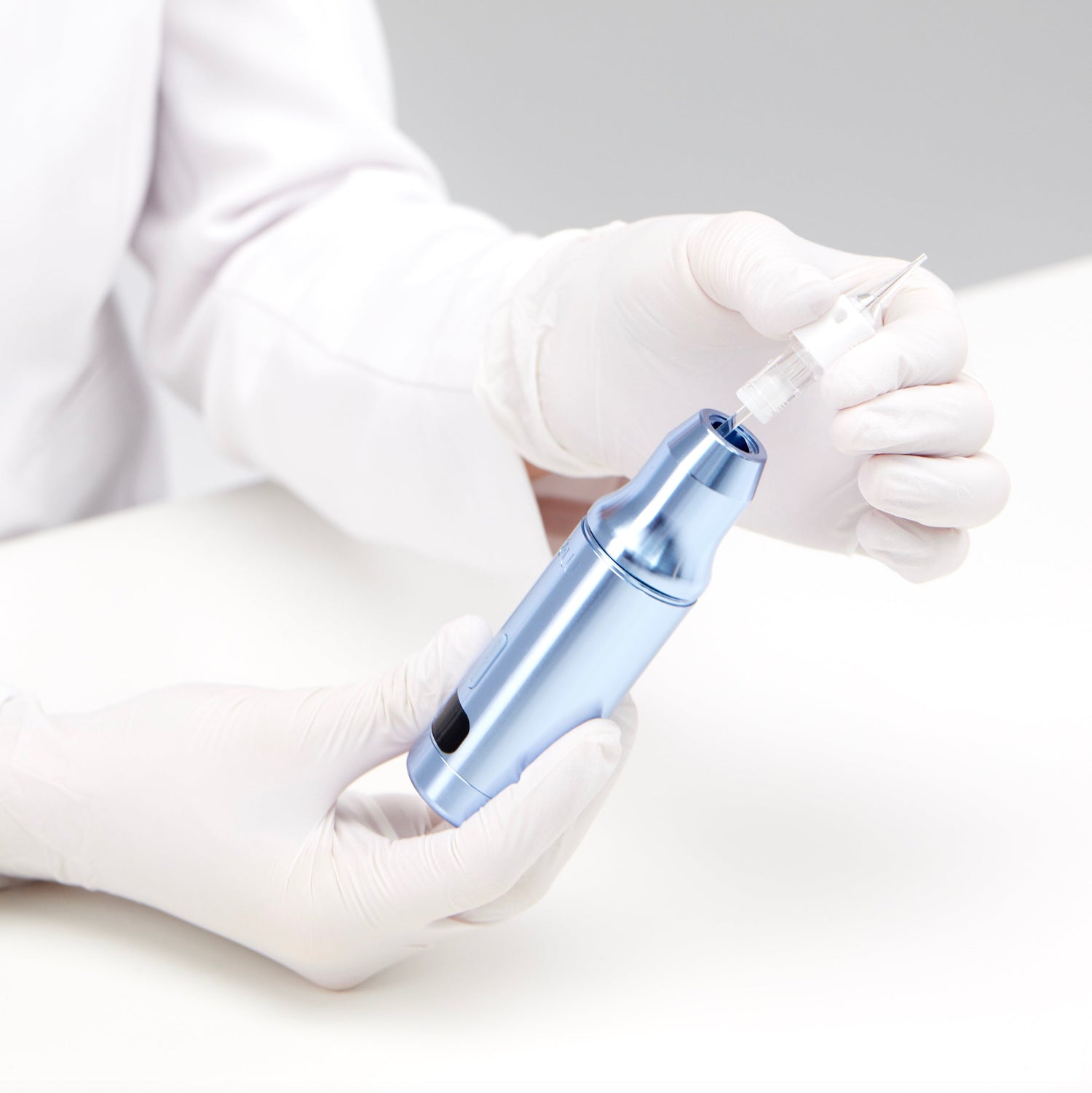
More and more devices are marketed as machines with "adjustable stroke" — for example "2.2–3.5 mm" or "5 strokes in one device." At first glance it sounds appealing: one machine, multiple settings. In theory — versatility. In practice — a serious engineering challenge that, in budget constructions, almost always ends in reduced performance.
Why This Happens
1. Variable stroke requires harmonized kinematics and drive — and that's rarely achieved
The idea of changing the stroke geometry itself isn't flawed, if the design is thought through from the ground up. For a variable stroke to actually work, four conditions must be met:
- the eccentric must be dynamically balanced at every stroke position,
- the motion path must be rigid and free of play (no "springing" or side movement),
- the drive must maintain angular velocity (ω) under load (skin or cartridge resistance),
- the velocity and acceleration profile of the needle must remain consistent and repeatable.
If these conditions aren't met, angular velocity (ω) drops under load, and acceleration drops with it — since a∝ω²r. This directly reduces the needle's impact force, producing an empty stroke.
This isn't a matter of some vague "balance between speed and power." More precisely: the speed you set (what you dial in on the device) is not the same as the speed maintained under load. Efficiency depends on the available torque (τ) at a given ω. When available τ < load τ, the device slows down and loses impact energy.
2. Advertised parameters like "2.2–3.5 mm stroke + 4 mm needle protrusion" are inefficient by design
With that much needle protrusion:
- the needle doesn't have enough time to retract far enough into the cartridge chamber to reload pigment,
- dwell time (contact time with the skin) shortens,
- lateral forces and friction increase, causing additional energy loss,
- the amount of pigment delivered per hit decreases.
As a result, the stroke becomes inefficient, especially at the upper end of the range (3.0–3.5 mm).
Practical limit: in typical compact PMU drives, a variable stroke only makes sense up to around 2.8 mm — and even then, only under specific design conditions. Above 2.5–2.8 mm, most brushed and coreless motors can't maintain sufficient torque against skin resistance or pigment viscosity, which produces an empty stroke — motion without energy, despite an impressive-looking spec sheet.
3. "Five strokes in one device" is usually a marketing claim, not a real feature
Designing a variable-stroke system that actually works is possible, but it requires a level of precision and mechanical quality not found in budget devices. In most cases, these designs don't deliver stable impact across the entire declared range — their "versatility" stays theoretical, not practical.
This is especially visible in devices offered in the $200–300 range and marketed as five-strokes-in-one machines. At that price point, it isn't possible to simultaneously fund a dynamically balanced eccentric, a rigid, play-free motion path, and a drive capable of maintaining torque under load across the full declared range — the components and quality control required to meet the conditions described above cost more than the price of the entire device. The offer can sound appealing, but it's worth thinking through: at that price range, genuine five-stroke versatility is physically and economically unachievable, regardless of what the spec sheet claims.
Clarifications
- Speed — the target number of cycles per second. Real performance depends on the speed maintained under load, which is limited by the available torque (τ).
- Needle impact — increases with acceleration (a∝ω²r) and drops when the drive fails to sustain speed, or when mechanical energy is lost to friction, play, or imbalance.
- Needle protrusion — the longer it is, the less time the needle spends inside the cartridge chamber → less pigment pickup per hit, and greater overall losses.
What This Means for the Artist
A variable stroke can work, but only within a narrow range (usually up to ~2.8 mm), and only if the entire system — from mechanics to drive control — is designed coherently.
Machines advertised as "2.2–3.5 mm stroke + 4 mm needle protrusion" will not be efficient in practice. If, during work, you notice empty spots, the need to press harder, or very little pigment after wiping — these are the classic signs of an empty stroke: motion without energy.
How It's Solved in ME
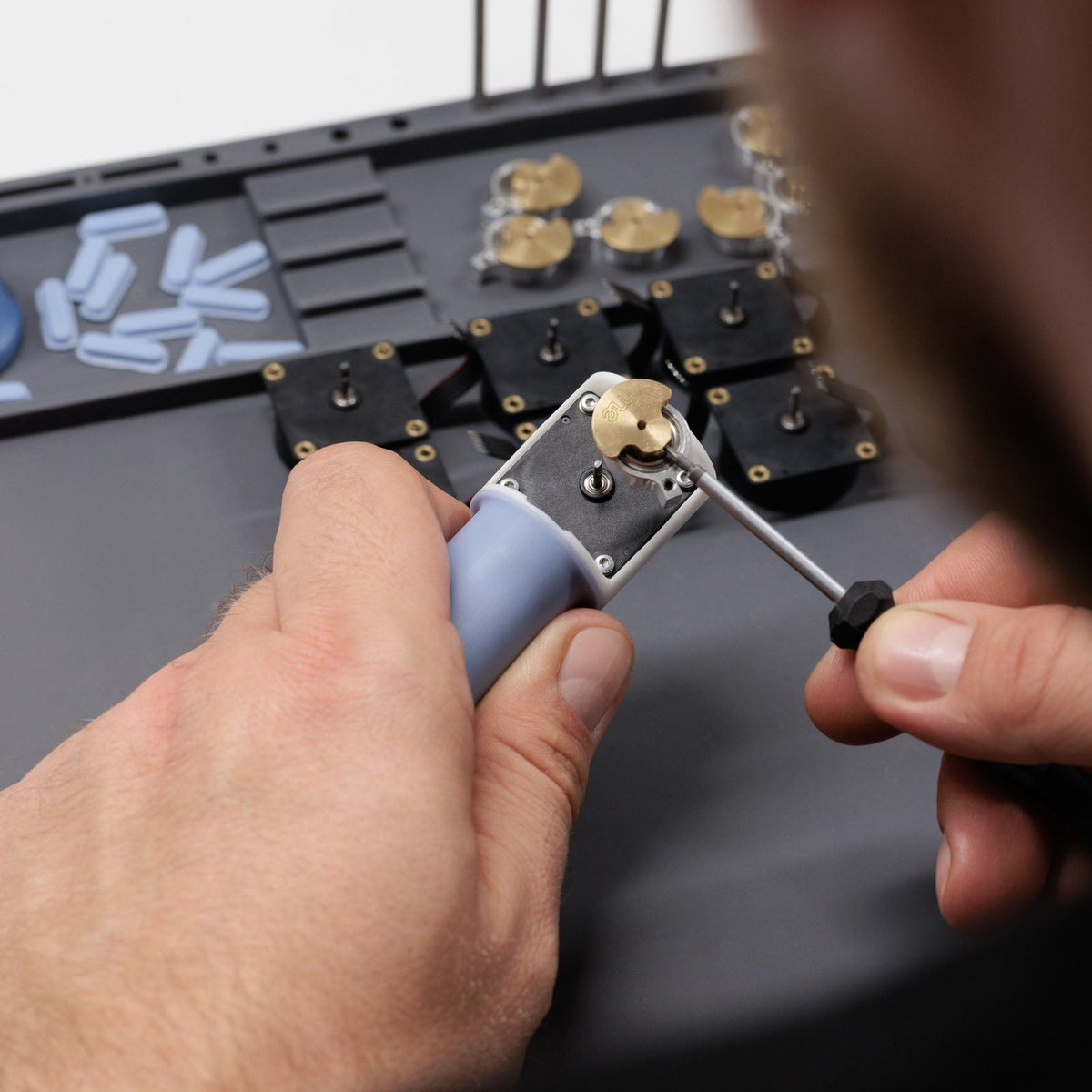
The ME device uses two independent, real strokes — 2.8 mm and 3.5 mm — both carefully developed and tested for genuine efficiency: maintaining speed under load, predictable dwell time, and stable impact in the skin.
This is a real, functional stroke, not just a number on a spec sheet — a parameter engineered for practical performance and consistency, not marketing appeal. The Motion Control system, with its four needle-behaviour profiles (Lips, Hairstroke, Powder, Satin), operates within these same two mechanical strokes — changing the dynamics of the needle's movement, not the stroke itself.
Summary
- Variable stroke sounds versatile, but is extremely difficult to execute effectively.
- Most designs claiming a wide stroke range (2.2–3.5 mm) lose efficiency due to physical and mechanical limits.
- A stroke's usefulness depends on how much energy is actually delivered into the skin, not on the declared distance.
- In ME, each stroke is engineered for real efficiency — stable, predictable, and truly effective in every technique.

Leave a comment
All comments are moderated before being published.
This site is protected by hCaptcha and the hCaptcha Privacy Policy and Terms of Service apply.